

Last updated: December 15, 2025
In modern homes, we increasingly talk about comfort, thermal efficiency and energy saving. However, we rarely consider the impact that the air we breathe has on our daily wellbeing. Scientific studies show that indoor air can be up to five times more polluted than outdoor air, and in Lithuania — especially during the heating season — the concentration of fine particles in the air often exceeds World Health Organisation (WHO) recommendations.
MVHR systems help reduce this negative impact — but only when MVHR filters are working effectively. Contaminated filters not only lose their protective function, but can also become a health risk.
MVHR Filter Classes: What Do G4, M5, F7 and Activated Carbon Filters Capture?
When choosing filters, it is important to understand what they protect against and which particles they are able to capture. Indoor air quality is affected by particles of various sizes — from coarse dust to microscopic bacteria and smog compounds. Each filter class serves a different purpose.
G4 filters are primary filters that capture coarse dust, hair, insects and larger pollen particles. They effectively protect the MVHR unit itself, but offer very limited protection against health-hazardous fine particles.
M5 filters are the most commonly used standard in Lithuanian homes. They capture most pollen, dust mites and mould spores and effectively filter particles as small as 1–2.5 microns — the particles most commonly responsible for allergies and respiratory irritation.
F7 filters are high-efficiency fine particle filters, capable of capturing up to 90–95% of particles from as small as 0.3 microns. For comparison, many bacteria (such as staphylococci and streptococci) and smog particles measure between 0.3 and 2 microns. For this reason, F7 filters are recommended for people living in cities, near busy roads, or those suffering from allergies.
Activated carbon filters provide additional protection against odours and gases. They absorb cigarette smoke, cooking smells, combustion by-products and industrial gases. This is particularly important for apartment dwellers, where neighbouring cigarette smoke or airborne viruses can enter through ventilation systems or open windows. Activated carbon also captures chemical compounds responsible for smog formation.
Why Are Contaminated Filters Dangerous? 5 Science-Based Reasons
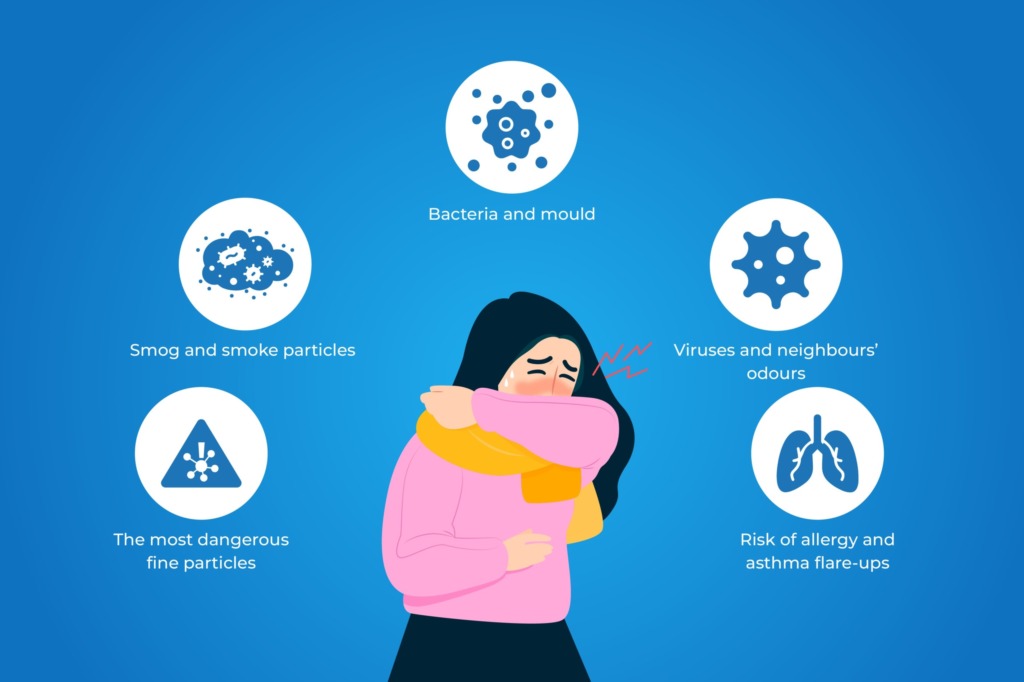
1. The Most Dangerous Fine Particles Enter Indoor Spaces
The smallest particles — invisible to the naked eye — are the most harmful. In Lithuania, during 2023, their levels exceeded WHO recommendations in all major cities. These particles penetrate deep into the lungs and even the bloodstream, increasing the risk of cardiovascular and respiratory diseases. A contaminated filter can no longer stop these particles — airflow weakens, and pollution simply bypasses the filter material.
2. Smog and Smoke Particles Enter Homes During the Heating Season
Lithuanian winters are associated with higher smog levels, caused by fuel burning, poor air circulation and stagnant air. Smoke particles are often smaller than 1 micron, meaning only M5 or F7 filters can effectively capture them. An old filter can lose up to half of its filtration efficiency, allowing smog to easily enter living spaces.
3. Contaminated Filters Become Breeding Grounds for Bacteria and Mould
Damp, dusty filters create ideal conditions for microorganisms to multiply. If filters are not replaced for longer than 3–6 months, the MVHR system may begin to blow back unpleasant odours, bacterial particles or mould spores. This is particularly dangerous for young children, older adults and people with weakened immune systems.
4. Higher Risk of Inhaling Viruses and Neighbours’ Odours in Apartment Buildings
Viruses themselves are extremely small, but they often travel attached to other particles, which F7 filters can capture with up to 95% efficiency. This reduces the risk when a neighbouring resident ventilates while ill or when smoke and odours circulate in the air. Activated carbon ensures that odours and gases do not spread between flats.
5. Increased Risk of Allergies and Asthma Flare-Ups
Pollen and mould spores are among the most common allergy triggers. Studies show that opening windows can allow up to 70% of outdoor pollen indoors. When filters are old and allow more particles through, people with allergies feel the effects immediately — runny nose, coughing, sneezing and breathing difficulties.
An MVHR system can be a powerful tool for creating a healthier indoor environment — but only when filters are properly maintained. Contaminated filters not only fail to protect against air pollution, but can actually increase it. For this reason, experts recommend replacing MVHR filters every 3–6 months, and activated carbon filters even more frequently.
If you are looking for reliable, certified MVHR filters, Filter loop offers a wide range of filters, home delivery and personalised advice based on your system model.
Article prepared by Paulina Padeginskaite