

Last updated: October 5, 2026
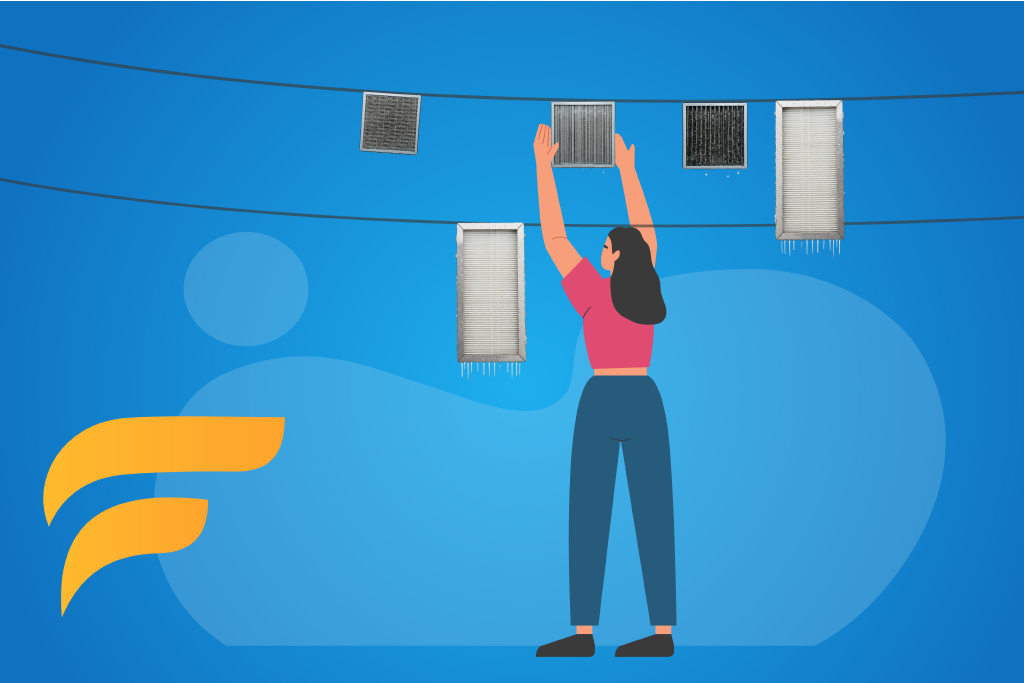
Have you ever taken a darkened, dust-covered filter out of your MVHR unit and thought, “Why buy a new one when I can simply wash this one?” It seems logical – water washes away the dirt, the filter looks clean again, and you save the cost of a new set.
However, how a filter looks does not necessarily tell you how well it performs after cleaning. The structure of the filter media, its ability to capture fine particles, airflow characteristics and even the shape of the filter can be more important than how clean it looks.
So, can MVHR filters actually be washed? Let’s look at what filter manufacturers’ recommendations and scientific research say.
Why Is It Tempting to Wash MVHR Filters?
The reason is simple – to save money. When you remove a filter from an MVHR unit and see a thick layer of dust, it may seem that all you need to do is wash it, let it dry and use it for another few months.
However, a filter is not simply a mesh screen. Its purpose is to capture airborne particles while maintaining the appropriate airflow resistance for the specific MVHR system.
What Can Happen If You Wash a Disposable Filter?
Water and intensive mechanical cleaning can damage the structure of the filter fibres, while a damp cardboard frame may become deformed. If the filter no longer fits properly after cleaning, some of the air may pass around the filter media rather than through it.
Electrostatic filtration is another important consideration. The fibres in some filters designed to capture fine particles carry an electrostatic charge that helps trap particles. Scientific literature identifies cleaning electret filters as a challenge because, if the stored charge is lost during cleaning, filtration efficiency can decrease significantly.
Another issue is moisture. A 2001 study of HVAC filters observed bacterial growth on filters during prolonged periods when relative humidity exceeded 80%. In another study, under nearly saturated humid conditions, the number of fungal colonies on fibrous filters increased more than 100-fold. This does not mean that every filter that becomes damp will develop mould, but damp filter media should certainly not be put back into the unit.
Can You Simply Vacuum the Filter Instead?
Lightly vacuuming the surface may be used as a temporary maintenance measure if permitted by the manufacturer of the specific unit. For example, Zehnder states that its filters can be removed for vacuuming or replaced completely with new ones, while the Passivhaus Trust recommends checking filters every 3–6 months and, where appropriate, removing accumulated dust with a vacuum cleaner.
However, vacuuming does not restore a filter to its original condition, as some fine contaminants remain trapped within the filter fibres. It should therefore not be used as a way of indefinitely postponing filter replacement.
Which MVHR Filters Can Be Washed?
Only filters that the manufacturer explicitly identifies as washable or reusable should be washed. For example, washable metal filters and filters with other specialist constructions are available on the market. Systemair also offers a washable aluminium filter for specific VX units. This is not the same as a standard disposable pleated filter. Therefore, always check the instructions for your MVHR unit before cleaning its filters.
Do You Really Save Money by Washing Filters?
In the short term, you save the cost of a new set of filters. However, those savings become questionable if, after washing, you no longer know the filter’s actual efficiency or if its shape or airflow characteristics have changed.
A filter is a consumable component of an MVHR system. Replacing it is not simply about ensuring that it looks clean, but about maintaining its intended filtration performance.
How Can You Tell When It Is Time to Replace the Filters?
Look out for visibly darkened, dust-covered filter media, reduced airflow, increased noise from the unit and a filter replacement notification on the controller. Nilan also lists increased system noise and condensation on the inside of windows among the possible warning signs.
The replacement interval is not the same for every home. It is affected by outdoor air pollution, where you live, dust levels and the specific MVHR unit. You should therefore follow the instructions provided by the manufacturer of your particular system.
Frequently Asked Questions
Can a G4 filter be washed?
This cannot be determined by the filter class alone. G4 refers to a filtration class under the older EN 779 system; it does not indicate whether a filter is washable. Always check the instructions for the specific product.
Can an F7 or ePM1 filter be washed?
If the manufacturer does not state that the specific filter is washable, washing is not recommended. It is particularly important not to damage filter media designed to capture fine particles.
Can an MVHR filter be vacuumed?
Some manufacturers allow vacuuming as an interim maintenance measure, but vacuuming is not a substitute for replacing the filter with a new one.
What should I do if I don’t know which filters I need?
Search for filters using the exact manufacturer and model of your MVHR unit. Even filters that look very similar can differ in dimensions and filtration characteristics.
Wash or Replace?
If your MVHR filters are disposable, it is not worth experimenting with water. Regular filter replacement helps maintain effective air filtration and protects the ventilation system itself.
Filter Loop offers complete filter sets for a wide range of MVHR models – simply select your unit and choose the filter set designed specifically for it.